You have 0 items in your cart

Crafts that empower, uplift and inspire.
If you spend time with Nomcebo Ntuli, you’ll quickly discover that there’s a lot of personality behind her colourful wire baskets. She’s bubbly, full of ideas and has a real love for what she does. And when it comes to shaping wire, she knows exactly what she’s capable of. In fact, she calls herself the queen of shapes.
Nomcebo grew up watching her father, Alfred Ntuli, work with hard wire. He encouraged her to take the craft seriously from a young age, and he wasn’t one to let her get away with getting the shape wrong. If it wasn’t right, she had to start again. Looking back, she says those lessons are a big part of why she can shape wire so well today.
Even so, it took a while for her to find her feet in the craft. It was only in 2020, when she stopped working in retail during the COVID-19 pandemic, that she really began to dedicate herself to wire weaving.
Creativity had always been part of Nomcebo’s life, though. As a child, she loved working with her hands and was fascinated by her mother’s sewing machine. Her mother sewed clothes for people in the community, and Nomcebo eventually started helping her. She even designed her own dresses, which her friends admired and wanted for themselves. She can still design clothes, she says, but for now, wire weaving has her attention.
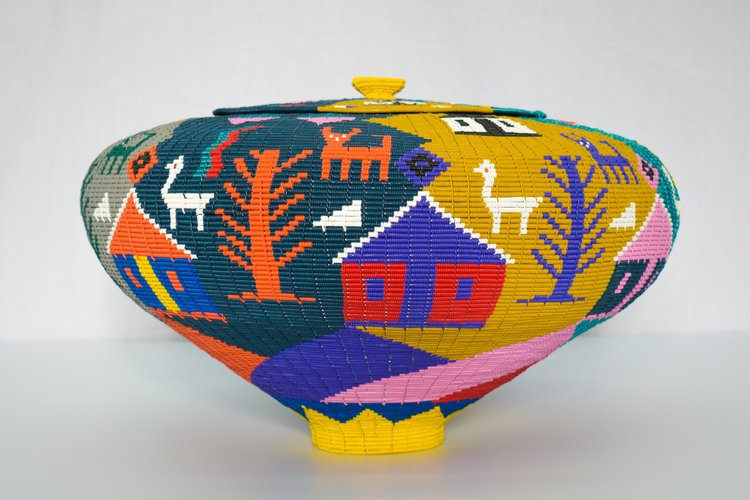
Today, Nomcebo works mainly with recycled telephone wire, creating ukhamba, the traditional Zulu beer pot, as well as vases, trinket bowls and shallow bowls. Her work is full of bright colours and intricate designs. Look closely and you’ll find birds, animals, trees, houses and Zulu homesteads woven into her pieces. The inspiration comes from the things she sees around her every day. Sometimes she’ll draw an idea first, and other times she’ll picture it in her head and figure out how to bring it to life as she works.
One of the things that stands out about her work is the detail she manages to create on a curved surface. Getting a picture to follow the shape of an ukhamba takes real skill, and Nomcebo makes it look almost effortless. She also enjoys making different shapes, including shallow bowls, which can be tiring to weave and aren’t everyone’s favourite. But that’s part of what makes her work her own.
A particularly important moment in her journey came when she made her first large ukhamba. It stood 45 centimetres tall and took her 18 days to complete, with intricate designs and lots of different bright colours. People were amazed by its size, and Nomcebo says it earned her a lot of respect as a hard-wire weaver.
But it meant something more to her personally. For the first time, she really felt that she had become an artist in her own right, rather than simply Alfred Ntuli’s daughter doing the same craft.
She remembers making a large pot while her father was still alive. As she worked, he looked at what she was doing and questioned whether the pot wasn’t getting too big. But when she finished it and made a lid to go with it, he was proud. Since then, Nomcebo has gone on to make even bigger and brighter pots. She believes her father would be amazed to see just how far she has taken the craft.
Her work has also travelled further than she has. In 2025, Nomcebo was accepted to participate in the International Folk Art Market in Mexico, but her visa was denied and she couldn’t make the trip. She applied for emergency funding from the National Arts Council and received it, allowing her work to travel to the market even though she couldn’t be there herself. In 2026, she was selected as a New Artist for the International Folk Art Market in Santa Fe, New Mexico, another exciting step in her journey.
For all the time and effort that goes into her work, Nomcebo knows that not every piece will turn out exactly as planned. Sometimes she has a picture in her head of how something should look, only for the finished piece to turn out differently. If she’s only completed the base, she might start over. If she’s already put in a lot of work, she’ll often carry on.
She’s learnt that what she sees as a mistake might not even be noticed by someone else. In fact, someone might love the very piece she’s not completely happy with. After all, she’s the one who knows what she wanted it to look like. The person admiring it sees something else entirely.
It’s a good reminder of why she believes patience and passion are so important in this craft. Nomcebo says hard-wire weaving isn’t for people looking to make quick money. She’s watched people start learning, ask how long it will take to finish a piece, and then give up when they realise the time and dedication involved. For her, you have to enjoy the process and be willing to put your heart into it. The finished piece is only part of the journey.
She’s also happy to share what she knows with people who are willing to learn. The children in her household have been taught the craft, and most have picked it up. During a visit, she showed a trinket bowl made by a nine-year-old in her family. It’s lovely to see the skill being passed on, especially through someone who understands just how much patience it takes to learn.
From the little girl who loved making things with her hands to the artist creating large, colourful ukhamba of her own, Nomcebo has come a long way. She’s taken a skill passed down by her father and developed it into something that reflects her own ideas, personality and creativity.
And with her love of colour, her eye for detail and all the shapes she’s still exploring, it seems the queen of shapes has plenty more up her sleeve.
 Small South African Flag Pin
R10.00
 Christmas Balls in Various Colours & Sizes
Price range: R50.00 through R160.00
 South African Flag Lanyard
R140.00
 Beaded Pen in Zulu Colours
R65.00
 Beaded Glasses Chain
R45.00
 Assorted Lanyards
R140.00
 South African Flag Beaded Key Ring
R35.00
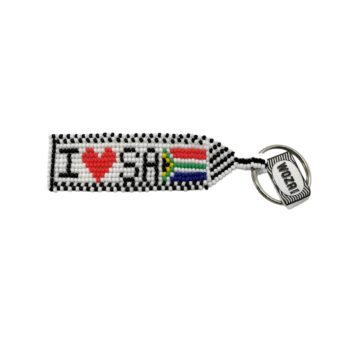 I Love SA Keyring
R50.00
 Stars: Beaded Stars
Price range: R50.00 through R65.00
 Pins: Beaded Pink Breast Cancer Ribbon with Pin
R25.00